Is the size of the machine related to the quality of the polish? In the…

Substrate Technology
CONSTRUCTION EQUIPMENT & SUPPLIES
1384 Bungalow Rd.
Morris, Illinois, U.S.A.
Terrazzo is one of the most beautiful and durable floor finishes in existence — some terrazzo floors have lasted a century and still shine. Whether you’re polishing a fresh terrazzo installation or bringing a worn, decades-old floor back to life, the process rewards patience and the right tools. Here’s how terrazzo polishing and restoration actually work.
A note on our experience: Substrate Technology is a member of the National Terrazzo & Mosaic Association (NTMA), and we manufacture our own patented terrazzo polishing pads. This is a craft we know deeply.
First, Know Your Terrazzo
Terrazzo comes in two main types, and knowing which you have matters:
- Epoxy terrazzo — marble, glass, or other aggregate set in an epoxy resin matrix. Common in modern installations, it’s poured thin over a substrate.
- Portland (cementitious) terrazzo — aggregate set in a cement matrix. This is the traditional, older style you’ll find in historic buildings, schools, and institutions.
Both are polished through a similar diamond process, but they behave differently under the tooling, and older portland terrazzo often needs more care and repair. Good tooling handles both — our STI Terrazzo Pads, for instance, are formulated for epoxy- and portland-based terrazzo alike.
Polishing New Terrazzo
When terrazzo is freshly installed, it’s rough and uneven — the aggregate isn’t yet exposed or smooth. Polishing brings it to life:
Step 1: First cut (grinding). The first pass flattens the floor and exposes the aggregate, cutting down the high points of the matrix and stone until you have a uniform, level surface with the aggregate showing. This is the most aggressive step, and getting the floor truly flat here is what makes everything after it work.
Step 2: Refine through the grits. From the first cut, you work through progressively finer diamond abrasives. Each step removes the scratches left by the previous one, gradually refining the surface and building clarity. This is where a versatile pad earns its keep — our STI Terrazzo Pads use a specialized matrix that cuts aggressively while leaving a fine scratch pattern, so they work as both the first cut and through the intermediate steps, available in grits from 35 through 400.
Step 3: Grout (if needed). On some terrazzo — especially portland — small pinholes and voids appear as you grind. A grout coat fills these, and once cured, you continue polishing. This step gives you that solid, hole-free finished surface.
Step 4: Close and polish. The final steps bring up the shine. Finer pads close the surface and develop the gloss, taking the floor to the clarity and reflection the job calls for.
Restoring Old Terrazzo
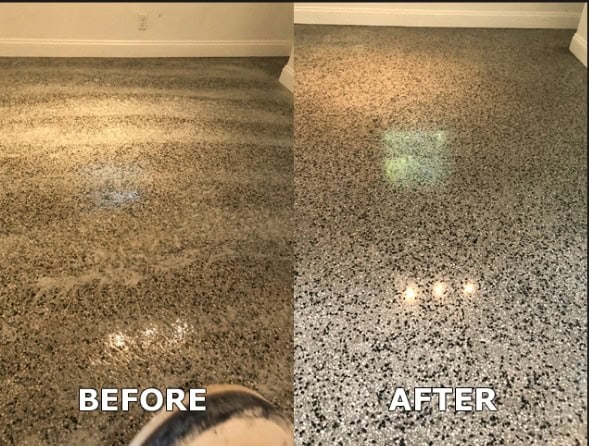
Restoration is where terrazzo really rewards you — a dull, scratched, decades-old floor can come back to a mirror shine, and it’s often far cheaper than replacing it.
Step 1: Assess and repair. Old terrazzo often has cracks, chips, or missing sections. These get repaired and patched first — matching the repair to the existing terrazzo — before any polishing begins.
Step 2: First restoration cut. Start with an aggressive cut to remove years of wear, old sealers, scratches, and surface damage, getting down to fresh, sound terrazzo. Our STI Terrazzo Pads are built to serve as this first restoration step, cutting through wear while setting up the finer work to come.
Step 3: Refine and polish. Just like new terrazzo, work through the grits — each step refining the last — until the floor reaches a smooth, high-gloss finish. The aggregate reappears crisp and clear, and the shine returns.
Step 4: Seal and protect. A finished terrazzo floor is typically sealed to protect it and make maintenance easier. From there, terrazzo is famously low-maintenance — routine cleaning keeps it looking sharp for years.
Wet vs. Dry
Terrazzo is often polished wet — water cools the pads, controls dust, and clears the slurry as you work, which is well suited to the fine stone and matrix of terrazzo. Our STI Terrazzo Pads are designed for wet use for exactly this reason. Wet polishing also sidesteps much of the airborne dust concern that comes with dry grinding, though you’ll manage slurry instead.
Why the Right Pads Matter
Terrazzo is a finish where quality is visible — every swirl, every uneven spot, every missed scratch shows in the final gloss. The pads you use directly shape the result:
- A pad that cuts aggressively but leaves a fine scratch pattern saves steps and gives a cleaner progression.
- A pad formulated for both epoxy and portland terrazzo handles whatever floor you encounter.
- A consistent, quality diamond matrix produces an even finish without chasing swirls.
This is why we manufacture our own terrazzo pads rather than reselling someone else’s — the STI Terrazzo Pads, Terrazzo+, and Terrazzo REDZ are patented, made to our specification, and trusted by terrazzo contractors who do this every day.
The Bottom Line
Polishing terrazzo — new or old — is a progression: cut to flatten and expose the aggregate, grout any voids, then refine through the grits to a high-gloss finish. Restoration adds repair and a more aggressive first cut, but the path to shine is the same. Do each step in order, don’t skip grits, and use quality diamond tooling matched to your terrazzo, and you’ll get a floor that looks stunning and lasts for generations.
We Know Terrazzo
At Substrate Technology, terrazzo is in our roots. As an NTMA member and the manufacturer of our own patented terrazzo polishing pads, we carry the full terrazzo toolkit — pads, tooling, and the expertise to match them to your floor.
Call (815) 941-4800 x 1 or contact us, and you’ll talk to a real surface-prep expert, not a call center.